


Understanding Today’s Weight Loss Revolution
Weight loss drugs are changing obesity treatment, offering new hope for millions. These FDA-approved medications target brain-gut hormones that control appetite, helping patients achieve significant weight loss when combined with lifestyle changes.
Current FDA-approved weight loss medications include:
- GLP-1 Receptor Agonists: Semaglutide (Wegovy), Liraglutide (Saxenda)
- Dual GIP/GLP-1 Agonists: Tirzepatide (Zepbound)
- Combination Medications: Naltrexone-bupropion (Contrave), Phentermine-topiramate (Qsymia)
- Fat Absorption Inhibitors: Orlistat (Xenical, Alli)
- Specialized Treatments: Setmelanotide (Imcivree)
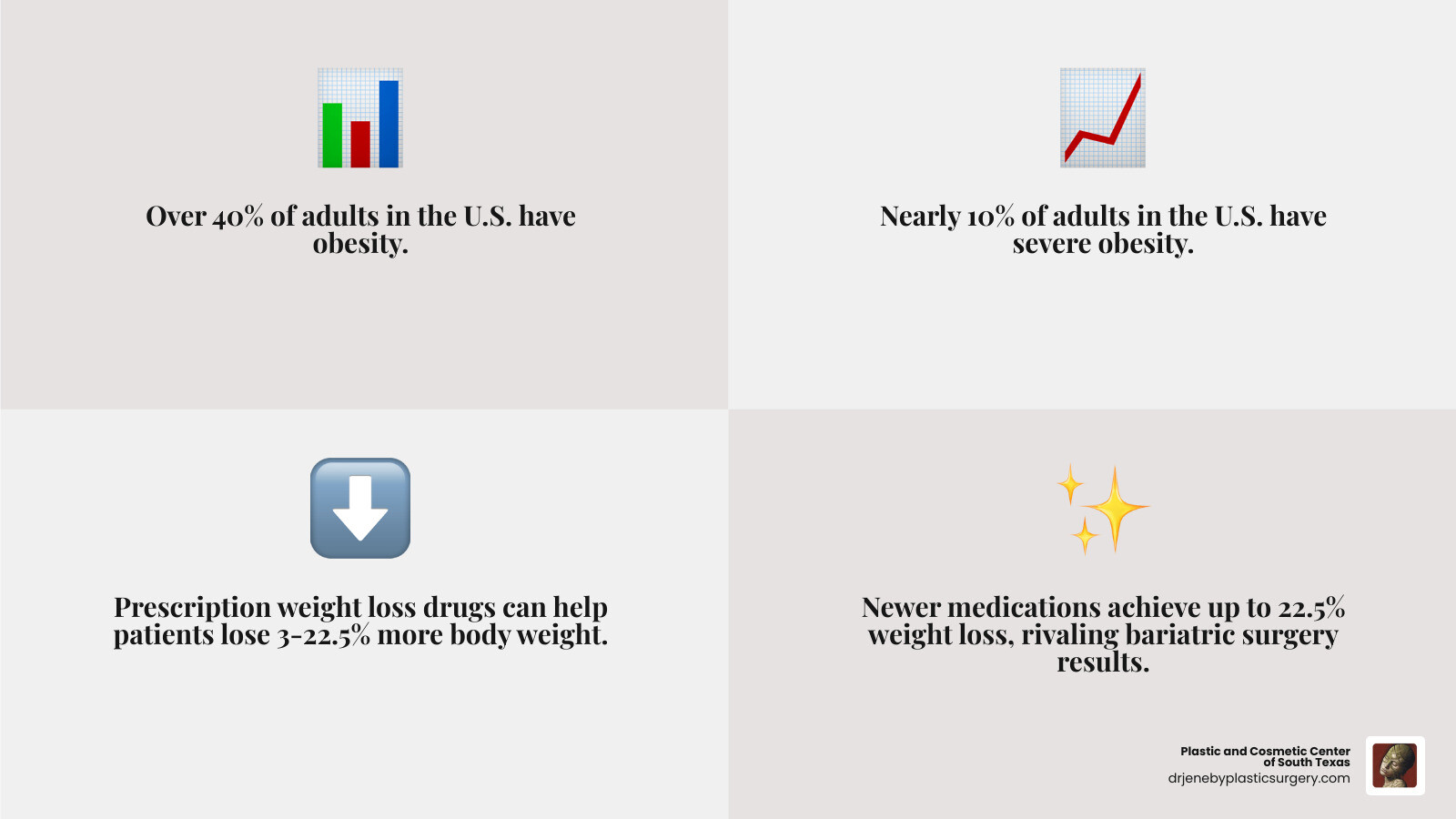
More than 4 in 10 adults in the United States have obesity. Clinical trials show that prescription weight loss drugs, used with diet and exercise, can help patients lose 3% to 22.5% more of their starting body weight compared to lifestyle changes alone. The newest medications like tirzepatide and semaglutide represent a breakthrough, with some patients achieving up to 22.5% weight loss—results that can rival bariatric surgery.
I’m Dr. Thomas Jeneby, and in my 20+ years of practice, I’ve seen how excess weight impacts health and confidence. My experience with weight loss drugs like semaglutide and tirzepatide has shown me their potential to help patients achieve their health and aesthetic goals more effectively than ever before.

Simple weight loss drugs glossary:
Understanding the Role of Weight Loss Drugs
Weight loss drugs are powerful medical tools, not magic pills. They are designed to work alongside your efforts to create lasting change by helping to control hunger signals and food cravings.
Your Body Mass Index (BMI) is a starting point for our conversation. A BMI of 30 or more is medically defined as obesity, a chronic condition often linked to serious health issues like high blood pressure, type 2 diabetes, and heart disease. Addressing weight can improve many aspects of your health at once. You can calculate your BMI to see where you stand and learn how our personalized weight loss programs can be custom for you.

Who is a Candidate for Prescription Weight-Loss Drugs?
These medications are for people facing significant weight-related health challenges. You may be a candidate if:
- Your BMI is 30 or greater (obesity).
- Your BMI is 27 or greater and you have a weight-related health problem like type 2 diabetes or high blood pressure.
- You have tried to lose weight through diet and exercise without sufficient success.
These drugs are not appropriate if you are pregnant, trying to conceive, or breastfeeding. However, some medications like semaglutide are approved for children over 12 with severe obesity.
How Do These Medications Work?
Modern weight loss drugs work with your body’s natural systems. Key mechanisms include:
- Appetite suppression: They change how your brain processes hunger signals, helping you feel satisfied with smaller portions.
- Reduced fat absorption: Some medications block a portion of dietary fat from being absorbed in your gut.
- Brain-gut hormone interaction: The newest drugs mimic hormones like GLP-1 and GIP, which your body naturally produces to regulate appetite. These hormones slow digestion, signal fullness to the brain, and help control blood sugar. Tirzepatide (Zepbound) targets both hormones for a more powerful effect. Learn more about GLP-1 agonists in our guide.
The Importance of Lifestyle Changes
Weight loss drugs are tools that give you the upper hand to build healthy habits. They quiet the “food noise,” making it easier to stick to a balanced, nutrient-dense diet and a consistent exercise routine. The federal physical activity guidelines recommend at least 150 minutes of moderate-intensity activity weekly.
Crucially, these medications help counteract your body’s natural response to weight loss (metabolic adaptation), where it increases hunger and slows metabolism. This gives you a fair chance against your own biology. Establishing these lifestyle foundations is key to long-term success, as we’ve seen in how nutrition and plastic surgery go hand in hand.
A Guide to FDA-Approved Weight Loss Medications
The world of weight loss drugs has expanded, offering a range of FDA-approved options for long-term and short-term use. The choice between injections and oral pills depends on effectiveness, convenience, and your personal health profile.

Here’s a comparison of the most prominent weight loss drugs:
| Medication (Brand Names) | Mechanism of Action | Administration | Average Weight Loss (% of body weight) |
|---|---|---|---|
| Tirzepatide (Zepbound) | Dual GIP/GLP-1 receptor agonist | Weekly injection | 22.5% |
| Semaglutide (Wegovy) | GLP-1 receptor agonist | Weekly injection | 14.9% |
| Liraglutide (Saxenda) | GLP-1 receptor agonist | Daily injection | 8% |
| Naltrexone-bupropion (Contrave) | Brain pathway targeting | Daily oral | 5-9% |
| Phentermine-topiramate (Qsymia) | Appetite suppression | Daily oral | 7-11% |
| Orlistat (Xenical, Alli) | Fat absorption inhibitor | Daily oral | ~5% |
GLP-1 and Dual GIP/GLP-1 Receptor Agonists
Injectable drugs have revolutionized obesity treatment.
- Tirzepatide (Zepbound) is the most effective medication currently available, with patients in trials achieving up to 22.5% average weight loss. It is a dual-action agonist, targeting both GIP and GLP-1 hormone pathways.
- Semaglutide (Wegovy) is a weekly GLP-1 agonist injection that helps patients achieve an average weight loss of 14.9%.
- Liraglutide (Saxenda) is an older, daily GLP-1 injection that results in about 8% weight loss.
These medications work by mimicking gut hormones to slow digestion and signal fullness. Common side effects include nausea, diarrhea, and vomiting, which usually lessen over time. There are rare but serious risks, including potential thyroid tumors and pancreatitis, which we will discuss thoroughly with you. See our detailed comparison of Tirzepatide vs. Semaglutide.
Oral Medications
For those who prefer pills, several effective options exist:
- Naltrexone-bupropion (Contrave) combines two drugs to reduce appetite and cravings, leading to 5-9% weight loss. It is not suitable for people with uncontrolled high blood pressure or seizure disorders.
- Phentermine-topiramate (Qsymia) is a combination pill that can lead to 7-11% weight loss but has contraindications, including for women of childbearing age not on effective birth control.
- Orlistat (Xenical, Alli) blocks about 25-30% of fat from being absorbed. It can cause digestive side effects like oily stools, especially with high-fat meals.
Specialized and Other Medications
Some treatments target specific needs. Setmelanotide (Imcivree) is for rare genetic disorders causing obesity. Hydrogel (Plenity) is a medical device in capsule form that absorbs water in the stomach to help you feel full. The history of withdrawn medications highlights the importance of choosing only FDA-approved drugs under medical supervision.
A Guide to FDA-Approved Weight Loss Medications
Navigating prescription weight loss drugs might seem overwhelming at first, but I’m here to walk you through your options in a way that makes sense. The FDA has approved several medications for weight management, each working differently to help you achieve your goals. Some are designed for short-term use, while others can be part of your long-term health strategy.

Let me break down the main categories of FDA-approved weight loss drugs we might consider for your journey:
| Medication (Brand Names) | Mechanism of Action | Administration | Average Weight Loss (% of body weight) |
|---|---|---|---|
| Semaglutide (Wegovy) | GLP-1 receptor agonist | Weekly injection | 14.9% |
| Tirzepatide (Zepbound) | Dual GIP/GLP-1 receptor agonist | Weekly injection | 22.5% |
| Liraglutide (Saxenda) | GLP-1 receptor agonist | Daily injection | 8% |
| Naltrexone-bupropion (Contrave) | Brain pathway targeting | Daily oral | 5-9% |
GLP-1 and Dual GIP/GLP-1 Receptor Agonists
These injectable medications have completely transformed how we approach obesity treatment. They’re game-changers because they work with your body’s natural hormone systems to help you feel satisfied with less food.
Semaglutide (Wegovy) is probably the medication you’ve heard the most about lately. While its cousin Ozempic treats diabetes, Wegovy is specifically designed for weight management. It mimics your body’s GLP-1 hormone, which naturally tells your brain “I’m full” and slows down how quickly food leaves your stomach. In the landmark STEP 1 trial, patients achieved an impressive 14.9% average weight loss over 68 weeks.
The most common side effects you might experience include nausea, diarrhea, vomiting, and constipation. I won’t sugarcoat it – these can be uncomfortable, especially when you’re starting or increasing your dose. The good news is they usually get better as your body adjusts. We also need to discuss some serious but rare risks, including potential pancreatitis and a theoretical thyroid tumor risk that we’ve only seen in animal studies.
Tirzepatide (Zepbound) is what I consider the current champion of weight loss drugs. While Mounjaro treats diabetes, Zepbound is approved specifically for weight management. What makes this medication special is that it’s a dual agonist – it targets both GLP-1 and GIP hormone pathways. Think of it as having two keys instead of one to open up your body’s appetite control system.
The results speak for themselves. In the SURMOUNT-1 trial, patients achieved up to 22.5% average body weight reduction at 72 weeks. That’s groundbreaking – we’re talking about results that can rival surgical interventions for many people. The side effects are similar to semaglutide, with gastrointestinal issues being the most common.
If you’re curious about how these two powerhouses compare, I’ve written a detailed comparison in our Tirzepatide vs. Semaglutide article.
Liraglutide (Saxenda) is the older sibling in this family. While Victoza treats diabetes, Saxenda is for weight management. It works similarly to semaglutide but requires daily injections instead of weekly. Patients typically see about 8% average weight loss, which is still significant and life-changing for many people.
Oral Medications
Not everyone is comfortable with injections, and that’s perfectly okay. We have several effective oral weight loss drugs that might be right for you.
Naltrexone-bupropion (Contrave) is like having a conversation between two different parts of your brain about food. Naltrexone, typically used for addiction treatment, teams up with bupropion, an antidepressant, to work on specific brain pathways that control appetite and cravings. This combination typically leads to 5-9% average weight loss.
You might experience nausea, constipation, headaches, or dizziness, especially when starting. However, this medication isn’t suitable for everyone. If you have uncontrolled high blood pressure, seizure disorders, or take opioid medications, we’ll need to explore other options. There’s also an important warning about increased risk of suicidal thoughts, particularly in young adults.
Orlistat (Xenical, Alli) takes a completely different approach. Instead of working on your brain, it works in your digestive system, blocking about 25-30% of the fat you eat from being absorbed. Xenical is the prescription strength, while Alli is available over-the-counter. People typically lose about 6-7 pounds or roughly 5% of their body weight.
I’ll be honest – the side effects can be socially challenging. You might experience oily stools, gas with discharge, and difficulty controlling bowel movements, especially if you eat high-fat meals. Think of it as your body’s way of encouraging you to stick to a lower-fat diet.
Phentermine-topiramate (Qsymia) combines an appetite suppressant with an anti-seizure medication to create a powerful weight loss tool. Depending on your dose, you might achieve 7-11% weight loss. Common side effects include numbness, tingling, dizziness, trouble sleeping, and constipation.
This medication requires special precautions if you’re a woman of childbearing age, as it can cause birth defects. We’ll need to ensure you have a negative pregnancy test before starting and use effective birth control throughout treatment.
Specialized and Other Medications
Some weight loss drugs serve very specific populations or work through unique mechanisms.
Setmelanotide (Imcivree) is highly specialized, approved only for people with specific rare genetic conditions that cause severe obesity. We’re talking about conditions like POMC deficiency, PCSK1 deficiency, and LEPR deficiency. If you have one of these rare conditions, this medication can be life-changing, but it requires genetic testing to confirm eligibility.
Hydrogel (Plenity) isn’t technically a drug – it’s a medical device made from cellulose and citric acid. You take it as capsules before meals, and it absorbs liquid in your stomach, creating a feeling of fullness. Real-world studies show about 9% average weight loss.
The field of obesity medicine has learned from past mistakes. Some withdrawn medications like Lorcaserin (Belviq) were removed from the market due to safety concerns. This is why we stay current with all FDA approvals and safety updates – your wellbeing is our top priority.
The Treatment Journey: What to Expect
Starting weight loss drugs is a commitment to a long-term health strategy. Obesity is a chronic condition, and like treatments for high blood pressure, these medications are often intended for long-term use to maintain results.

If you stop taking the medication, weight regain is common as your body’s hunger signals and metabolism revert to their previous state. This is why building sustainable lifestyle habits while on the medication is critical for long-term success. We have more information on treatment duration in our guide, How Long Do You Have to Be on Semaglutide for Weight Loss?.
Choosing the right drug is a personal decision based on your health history, goals, lifestyle, and potential side effects. We will work with you to find the best fit.
Costs and Insurance Coverage
The newer injectable weight loss drugs can be expensive, with annual costs potentially exceeding $13,000, according to a Kaiser Family Foundation report. Insurance coverage is inconsistent; Medicare does not currently cover these drugs for weight loss alone, and private plans vary. Always check with your provider about coverage, prior authorization, and out-of-pocket costs. If coverage is denied, we can help you with the appeals process.
Safety, Counterfeits, and the Future
Your safety is our top priority. Always take medication exactly as prescribed and report any side effects. A major concern is the rise of counterfeit drugs sold online. The FDA warns against unapproved drugs because they can be ineffective or dangerous. Compounded versions are not FDA-approved and carry risks we can discuss, as detailed in our article on Compounded Tirzepatide.
The future is bright, with new oral medications and even more effective treatments like orforglipron and MariTide in development, promising more personalized options ahead.
Frequently Asked Questions about Weight Loss Medications
Here are answers to the questions we hear most often about weight loss drugs.
What is the most effective prescription for weight loss?
By the numbers, tirzepatide (Zepbound) is currently the most effective, with clinical trials showing an average weight loss of up to 22.5%. Semaglutide (Wegovy) is also highly effective, showing a 14.9% average loss. However, the “most effective” medication is the one that works best for your unique body, health profile, and lifestyle. A personal consultation is key to finding your best option.
What happens if I stop taking weight loss drugs?
Most people regain a significant portion of the lost weight after stopping. This is not a personal failure but a biological response. Obesity is a chronic disease, and the medications work by managing its underlying hormonal and metabolic drivers. When the medication is stopped, these drivers often return. This is why building lasting lifestyle habits is essential for long-term maintenance. You can read more about weight regain after stopping medication in medical studies.
What are the differences between prescription and over-the-counter weight loss drugs?
The difference is vast. Prescription weight loss drugs undergo rigorous FDA testing for safety and efficacy. We know how they work, their potential side effects, and have data from thousands of patients.
Over-the-counter (OTC) options, except for Alli (a lower-dose version of prescription orlistat), are typically classified as supplements. Supplements do not require FDA approval for safety or effectiveness before being sold. Many make unproven claims and can even contain unsafe ingredients. For safe and effective results, medical supervision with proven prescription weight loss drugs is the recommended path.
Your Path to a Healthier Weight
Beginning the journey to a healthier weight is a significant step, and you don’t have to do it alone. At Plastic and Cosmetic Center of South Texas, we understand that weight loss drugs are one component of a comprehensive, personalized plan.
Our approach combines the latest medical treatments with practical lifestyle strategies to help you build sustainable habits for long-term success. We partner with you, providing medical expertise and support to help you transform your relationship with food and health.
We are committed to making your journey accessible and have convenient locations in San Antonio and Austin, with in-house financing options available.
Ready to take the first step? Explore our Effective Weight Loss Strategies to see how we can help. When you’re ready to move forward, our Semaglutide Weight Loss Injections in San Antonio program offers the personalized support you deserve. Your healthiest, most confident self is waiting.


