


Understanding Financing for Plastic Surgery
When you’re thinking about plastic surgery, figuring out how to pay for it is a big part of the decision. In simple terms, financing plastic surgery can involve saving up, getting a loan, or using credit options designed for medical expenses. Here’s a quick look at the main points:
- Save up: Using cash saved over time is the most straightforward and cost-effective method.
- Loans: Personal loans, often unsecured, can be used to finance surgery, with interest rates based on your credit score.
- Medical credit cards: Options like CareCredit offer special financing for healthcare expenses, sometimes with promotional no-interest periods.
- In-house financing: Some clinics offer direct payment plans, allowing you to pay off your procedure over time without an external lender.
It’s critical to compare these options, considering interest rates, terms, and eligibility requirements, to find the most suitable way to finance your plastic surgery.
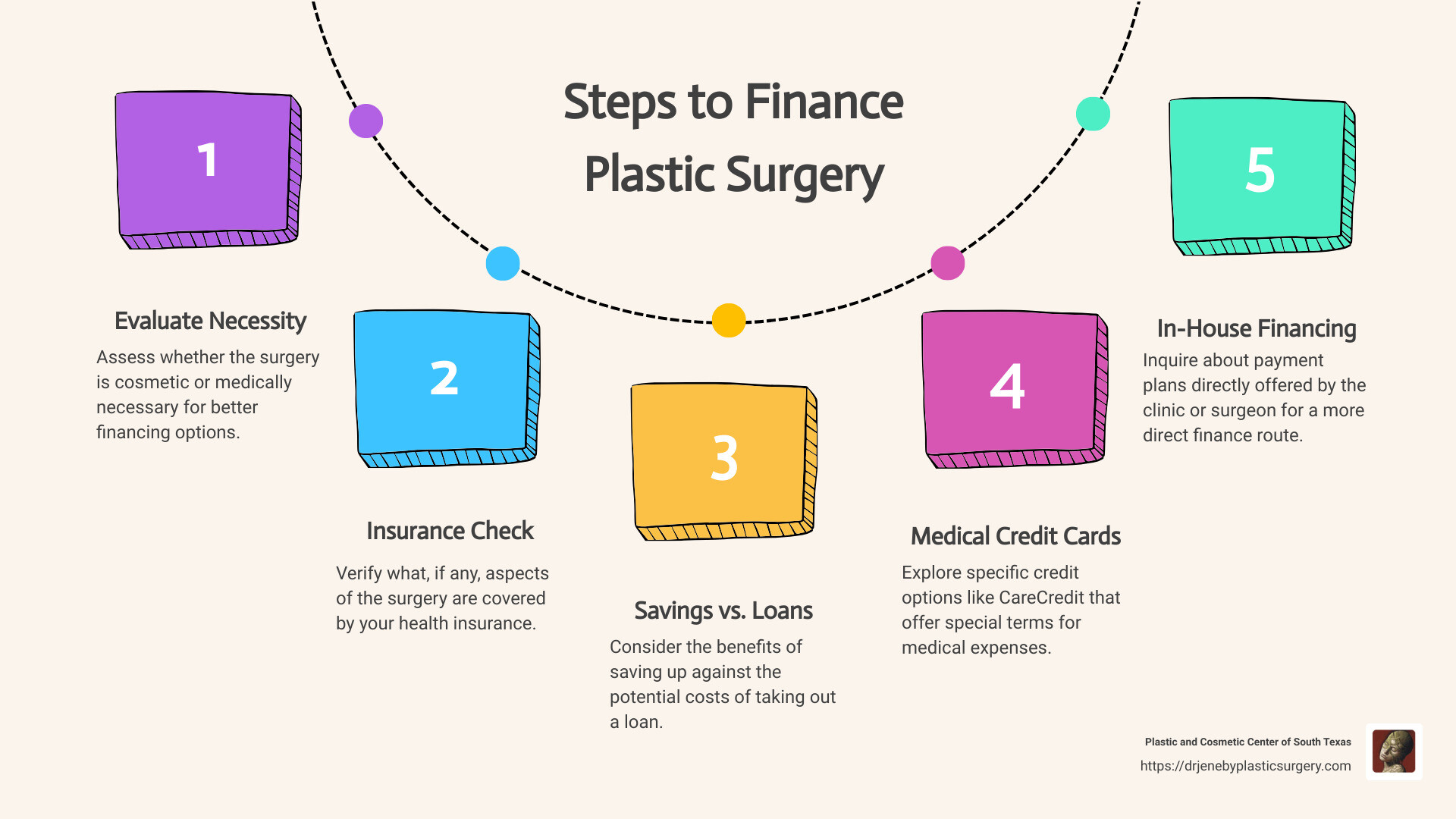
Whether you’re considering a necessary or cosmetic procedure, understanding your financing options can help you make an informed decision without unnecessary financial strain. This guide will cover the essentials of financing plastic surgery, from understanding the basics to navigating the complexities of loans and credit, all tailored to help you in your journey towards achieving your desired results with the Plastic and Cosmetic Center of South Texas.
Understanding Plastic Surgery Financing
When it comes to making your dreams of plastic surgery a reality, understanding how does financing work for plastic surgery is crucial. Let’s break it down into three key parts: Credit Score, Lenders, and Interest Rates. This section will help you grasp the essentials, ensuring you’re well-equipped to make informed decisions.
Credit Score
Your credit score is like a financial handshake. It tells lenders, “Hey, I’m good for it.” A higher score can open doors to better loan terms and lower interest rates. Think of it as your financial GPA; the better it is, the more likely you are to get favorable treatment. If your score isn’t where you want it to be, don’t worry. Some lenders are more flexible, and there are specific loans designed for those with less-than-perfect credit.
Lenders
Lenders are the folks who give you the money, hoping you’ll pay it back with a little extra (interest). They come in various flavors: banks, credit unions, online financiers, and even medical credit companies like CareCredit. Each has its own set of rules, rates, and requirements. It’s like shopping for a car; you want to check out all your options to find the best deal.
Interest Rates
Interest rates are the cost of borrowing money, expressed as a percentage. Think of it as the rental fee for using someone else’s cash. Rates can vary widely based on your credit score, the lender, and the loan terms. Lower rates mean you pay less over the life of the loan. Some medical credit cards offer promotional periods with zero interest, but be sure to pay off the balance before the promo ends, or you might get hit with all the accrued interest.
Navigating plastic surgery financing might seem daunting, but understanding these three components will put you on solid ground. Armed with this knowledge, you’re ready to explore the various financing options available, ensuring you can make your aesthetic dreams come true without breaking the bank. Next, we’ll dive into the popular financing options for plastic surgery, from personal loans to in-house financing, and everything in between.
Popular Financing Options for Plastic Surgery
Navigating plastic surgery financing can seem daunting, but understanding your options makes the process much simpler. Let’s break down the most popular ways people finance their plastic surgery, focusing on key aspects like APRs, loan terms, and minimum credit scores.
Personal Loans
Personal loans are a common choice for financing plastic surgery. They are typically unsecured loans, meaning you don’t need collateral. Here’s what you need to know:
– APRs: Vary widely, roughly from 6% to 36%, depending on your creditworthiness.
– Loan Terms: Can range from two to seven years, giving you flexibility in how long you have to pay back the loan.
– Loan Amounts: From $1,000 to $50,000, covering a wide range of procedure costs.
– Minimum Credit Score: Usually, a score of 600 or above is needed, but the best rates are reserved for those with excellent credit.
Credit Cards for Medical Use
Specific credit cards, like CareCredit, are designed for healthcare expenses, including plastic surgery. They offer unique benefits:
– APR: Can be high, but promotional financing options may offer periods of 0% interest.
– Promotional Financing: Often available for six, 12, 18, or 24 months. If you pay off the balance within the promotional period, you won’t pay interest.
In-House Financing
Some plastic surgery clinics offer direct financing to patients. This option involves:
– Payment Plans: Tailored to fit your budget, often with fixed monthly payments.
– Direct Doctor Collaboration: Allows for a streamlined process and potentially more flexibility on terms.
Secured Personal Loans
For those with less-than-ideal credit, secured personal loans might be an option. They require:
– Collateral: Such as a car or savings account, which could result in lower interest rates compared to unsecured loans.
Savings
Paying with savings is the most cost-effective method because it avoids interest and loan fees. Consider:
– Cost-effectiveness: No interest or additional fees to worry about.
– APYs: If you’re saving over time, look for a high-yield savings account to grow your funds faster.
When considering how to finance your plastic surgery, it’s crucial to compare these options carefully. Look at the APRs, understand the terms, and consider how a monthly payment will fit into your budget. The goal is to make your dream procedure a reality in a financially responsible way.
By weighing personal loans, specialized credit cards, in-house financing options, and the potential of using savings, you’re equipped to choose the best financing path for your situation. The Plastic and Cosmetic Center of South Texas is here to help guide you through the process, ensuring patient safety and satisfaction with flexible financing solutions tailored to your needs.
Factors Affecting Your Financing Options
When exploring how does financing work for plastic surgery, it’s crucial to understand the factors that can significantly influence your financing options. These include credit score impact, loan terms, interest accumulation, and the differences between secured and unsecured loans.
Credit Score Impact
Your credit score is a major player in the financing game. It can affect not only your ability to get a loan but also the terms of the loan. A higher credit score often means lower interest rates and better loan terms. If your score is on the lower side, you might face higher interest rates or even difficulty in getting approved for a loan.
Loan Terms
Loan terms refer to how long you have to pay back the loan. Shorter loan terms usually mean higher monthly payments, but you’ll pay less in interest over time. Longer loan terms can lower your monthly payments but increase the total amount of interest you’ll pay. It’s a balancing act between what you can afford each month and how much you’re willing to pay in the long run.
Interest Accumulation
Interest is the cost of borrowing money. It can add up quickly, turning a reasonably priced procedure into a costly venture over time. Understanding how interest accumulates on your loan or credit line is key. Some loans offer fixed interest rates, meaning the rate stays the same throughout the life of the loan. Others have variable rates that can change, affecting your monthly payments.
Secured vs. Unsecured Loans
Loans come in two main types: secured and unsecured. A secured loan requires collateral, like a car or home, which the lender can take if you fail to repay the loan. These loans often have lower interest rates because they’re less risky for lenders. Unsecured loans don’t require collateral but usually have higher interest rates due to the increased risk to the lender.
Choosing the Right Option for You
When considering how to finance your plastic surgery, weigh these factors carefully. A secured loan might offer better rates, but are you comfortable putting up collateral? An unsecured loan might be quicker to obtain but could cost more in the long run due to higher interest rates.
The goal is to find a financing option that fits comfortably within your budget without overextending yourself financially. The Plastic and Cosmetic Center of South Texas offers in-house financing options that might be a perfect fit, allowing you to achieve your aesthetic goals while maintaining financial stability.
As you move into the next section, keep these factors in mind. They’ll be crucial in navigating insurance, understanding the distinction between medically necessary and elective procedures, and ultimately deciding how best to finance your plastic surgery.
In the next section, we’ll dive into navigating insurance and plastic surgery, including what’s considered medically necessary versus elective and how insurance coverage plays into your financing decisions.
Navigating Insurance and Plastic Surgery
When considering plastic surgery, understanding how insurance plays a role is crucial. This can be a bit tricky since insurance companies often draw a line between medically necessary and elective procedures. Let’s break these down and see where reconstructive surgery fits into the picture.
Medically Necessary vs. Elective
Medically Necessary: These are procedures deemed essential for the patient’s health. Conditions like severe deviated septum, breast reconstruction post-mastectomy, or surgeries to correct congenital defects fall under this category. Insurance companies are more likely to cover these procedures because they are not just for improving appearance but are needed for a healthy life.
Elective: These are procedures done primarily for cosmetic reasons – think nose jobs for aesthetic purposes, liposuction, or facelifts. Since these surgeries are considered not essential for health, insurance companies typically do not cover them.
Insurance Coverage
Navigating insurance coverage can be daunting. Here’s a simple guide:
- Read Your Policy: Start by thoroughly reviewing your insurance policy. Look for sections on cosmetic, plastic, or reconstructive surgery.
- Consult Your Surgeon: Plastic surgeons often have experience dealing with insurance companies. They can provide insights on whether your case might be considered medically necessary.
- Pre-Authorization: For surgeries that might be on the edge, seek pre-authorization from your insurance. This means the insurance company agrees in advance that the procedure is medically necessary.
Reconstructive Surgery
Reconstructive surgery often blurs the lines between medically necessary and elective surgery. For instance, reconstructive breast surgery after mastectomy is generally covered by insurance due to its restorative nature. Similarly, surgeries correcting congenital defects or those required after traumatic injuries often receive coverage.
It’s important to communicate openly with both your surgeon and insurance provider. Providing detailed medical history and documentation can support your claim for coverage.
In summary, understanding the distinction between medically necessary and elective procedures is key in navigating insurance for plastic surgery. Always consult your insurance policy and discuss with your surgeon to explore your options. Even if insurance doesn’t cover your procedure, there are financing options available to help manage the costs.
In the next section, we’ll answer some frequently asked questions about financing plastic surgery, providing you with a clearer path on how to approach the financial aspect of your journey.
Frequently Asked Questions about Financing Plastic Surgery
Navigating the financial aspect of plastic surgery can be as daunting as deciding on the procedure itself. Let’s break down some common questions to help demystify the process.
How do most people finance plastic surgery?
Most people explore a variety of options when financing plastic surgery, including:
- Personal Loans: These are unsecured loans from banks or online lenders. They have fixed interest rates and repayment terms, but the rates can vary widely based on your credit score.
- Credit Cards: For smaller procedures or to cover gaps in financing, credit cards can be useful. Some cards offer promotional 0% APR periods, which can be advantageous if you can pay off the balance before the promotional period ends.
- Payment Plans: Many clinics, including the Plastic and Cosmetic Center of South Texas, offer in-house financing or payment plans. These plans can sometimes offer more favorable terms, like lower interest rates or no interest rates for a set period.
What credit score do you need to finance plastic surgery?
The credit score needed can vary significantly depending on the financing option:
- Personal Loans and Credit Cards: Generally, a credit score of 600 or above is needed to qualify for favorable terms. However, the higher your score, the better the interest rates and terms you’ll receive.
- In-House Financing: Some clinics may have more flexible requirements and might not solely base their decision on your credit score, focusing instead on your ability to repay.
How to finance a big surgery?
Financing a significant surgery requires careful consideration of all available options:
- Options Overview: Start by comparing personal loans, credit cards, and in-house financing options. Look at the APRs, terms, and any fees associated with each option.
- Pros and Cons:
- Personal Loans: Pros include fixed interest rates and repayment periods. Cons can be higher interest rates for those with lower credit scores.
- Credit Cards: Pros include the potential for 0% APR. Cons include high-interest rates after the promotional period and the temptation to overspend.
- Payment Plans: Pros include potentially more favorable terms and the ability to negotiate directly with your provider. Cons might include limited eligibility or higher overall costs if the terms are not carefully considered.
Other Considerations: Beyond the numbers, consider how adding a monthly payment for plastic surgery fits into your overall budget and financial goals. It’s also worth thinking about how quickly you can realistically pay off the balance, as interest can accumulate quickly on high balances.
Navigating the financing of plastic surgery requires a clear understanding of the options available and how they align with your financial situation. By carefully considering each option’s pros and cons and understanding the impact on your credit and overall finances, you can make an informed decision that allows you to move forward with your plastic surgery goals in a financially responsible manner. The goal is not just to finance your surgery but to do so in a way that maintains your financial health and well-being.
In the next section, we will conclude our guide by discussing the importance of patient safety, satisfaction, and the unique in-house financing options available at the Plastic and Cosmetic Center of South Texas.
Conclusion
At the Plastic and Cosmetic Center of South Texas, we understand that the decision to undergo plastic surgery is not just about enhancing your appearance—it’s about feeling confident and fulfilled. That’s why we prioritize patient safety and satisfaction above all. Our experienced surgeons employ advanced techniques with a compassionate touch to ensure outstanding results and a smooth recovery process.

When considering how does financing work for plastic surgery, we recognize that financial considerations play a significant role in your decision-making process. Hence, we offer a variety of in-house financing options designed to make plastic surgery accessible without compromising on quality or patient care. Our financing plans are tailored to fit your budget, allowing you to achieve your cosmetic goals without the stress of financial strain.

Our commitment to your well-being extends beyond the operating room. We believe in establishing a transparent and supportive relationship with our patients, ensuring that you are well-informed and comfortable with every aspect of your journey, including financing. Our team is dedicated to guiding you through the financing process, helping you find the plan that best suits your needs.
Choosing the right financing option is crucial, and at the Plastic and Cosmetic Center of South Texas, we’re here to help you navigate those choices. Whether you’re considering a minor enhancement or a significant transformation, you can trust us to provide expert care and support throughout your journey.
For more information on our services and to explore our financing options, please don’t hesitate to contact us. Let us help you take the first step towards the new you.
Investing in plastic surgery is an investment in yourself. With the right approach to financing, you can make your cosmetic dreams a reality, ensuring a positive impact on your life for years to come. At the Plastic and Cosmetic Center of South Texas, we’re not just about transforming appearances; we’re about enriching lives.


