


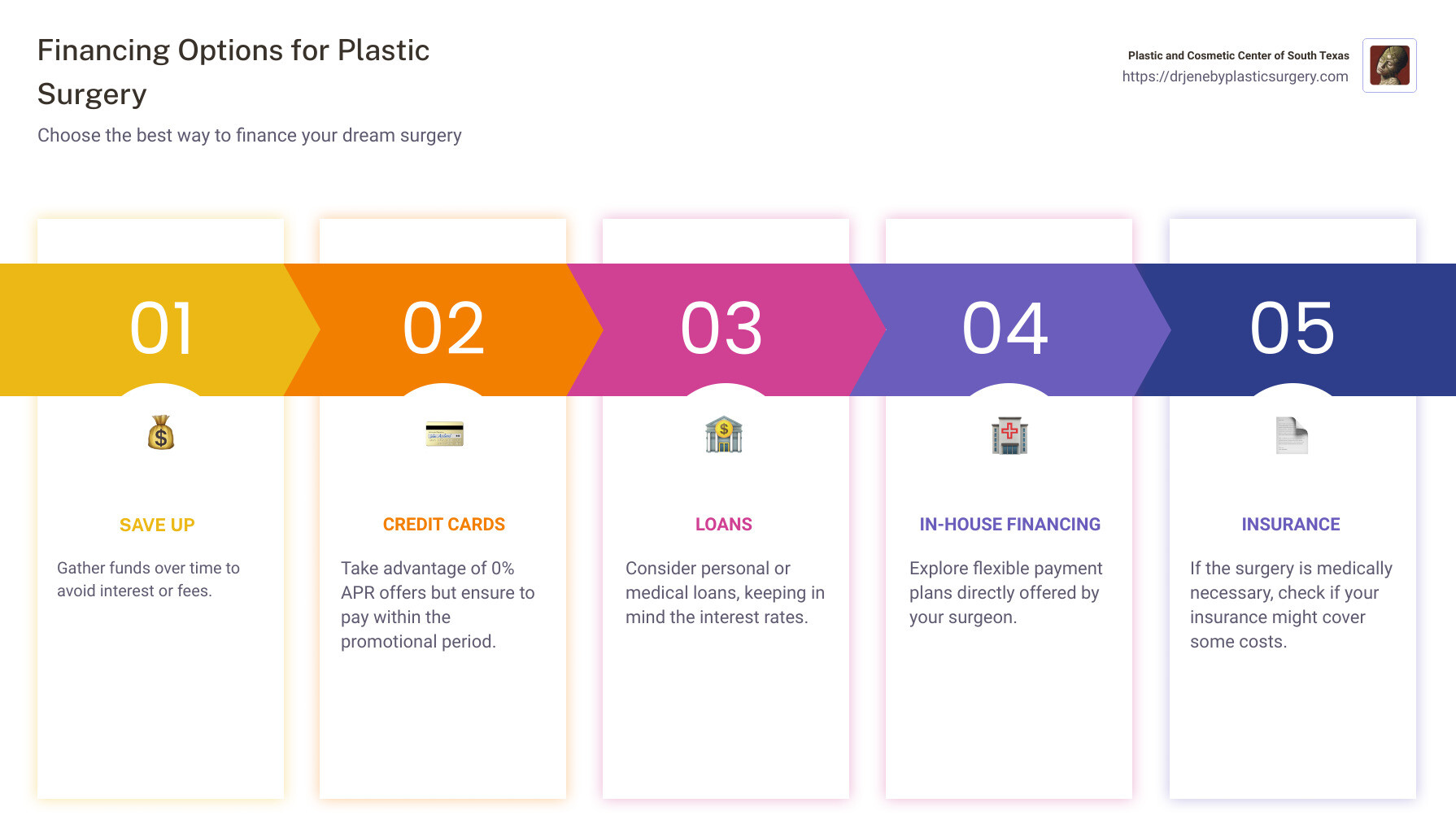
Quick Guide to Financing Plastic Surgery:
- Save up: Use savings for no interest or fees.
- Credit Cards: Look for 0% APR offers but pay within the intro period.
- Loans: Personal or medical loans, but interest rates apply.
- In-House Financing: Directly through your surgeon, potentially without interest.
- Insurance: If surgery is medically necessary, insurance may cover it.
Deciding to undergo plastic surgery can be life-changing. Whether it’s for cosmetic or medical reasons, the question of how to finance it is often at the forefront of your mind. Let’s make this simple. There are a few main ways to fund your surgery: savings, loans, credit cards, in-house financing, and sometimes, insurance. Each option has its pros and cons, and the best choice depends on your situation.
It’s crucial to understand your financial position and the implications of each method before making a decision. For instance, paying with savings could mean a delay while you gather funds but avoids interest. Loans and credit cards offer immediate funding but come with interest rates and potential fees. In-house financing can be a flexible option, often tailored to fit your budget, but details vary significantly between providers. And although rare, if your procedure is deemed medically necessary, insurance might cover some costs.
Let’s break it down and explore your options to make an informed decision on financing your plastic surgery.
Understanding Plastic Surgery Financing
When it comes to how does financing work for plastic surgery, three key factors play a crucial role: Credit score, Lenders, and Interest rates. Understanding these elements can help you navigate through your financing options more effectively.

Credit Score
Your credit score is like your financial fingerprint. It tells lenders how responsible you are with money. A higher credit score can open the door to better loan terms, including lower interest rates. If your score is on the lower side, you might still have options, but they could come with higher costs.
Key Point: The better your credit score, the better your financing options.
Lenders
There are various lenders out there, including banks, credit unions, online lenders, and healthcare financing companies like CareCredit. Each lender has its own set of criteria for loan approval and its own terms and conditions. Some might offer special financing options for medical procedures, including plastic surgery.
Pro Tip: Shop around. Don’t just go with the first lender you find. Compare rates and terms to find the best deal.
Interest Rates
Interest rates can significantly affect the total amount you’ll end up paying for your plastic surgery. Rates can vary widely depending on the lender, your credit score, and the loan term. Some medical credit cards offer promotional periods with 0% interest, but make sure you can pay off the balance before the promotional period ends to avoid high-interest charges.
Remember: Lower interest rates mean lower overall costs. Always read the fine print to understand the full cost of borrowing.
Navigating the Financing Maze
Understanding these three key components can make a big difference in your plastic surgery financing journey. Here’s a quick guide to help you start:
- Check Your Credit Score: Before you start looking for financing options, know where you stand. You can use free services to check your credit score online.
- Explore Lenders: Look at different lenders and what they offer. Consider all types of lenders, including those specializing in medical loans.
- Compare Interest Rates: Don’t just look at the monthly payment. Calculate the total cost of the loan, including interest and any fees.
Financing plastic surgery isn’t one-size-fits-all. By understanding how financing works, including the impact of your credit score, the variety of lenders available, and how interest rates affect your loan, you can make a more informed decision that fits your financial situation.
Next, we’ll dive into the popular financing options for plastic surgery, including the pros and cons of each, to help you find the best way to finance your procedure.
Popular Financing Options for Plastic Surgery
Navigating how to finance plastic surgery can seem daunting, but understanding your options can make the process clearer and more manageable. Let’s explore the most common financing routes.
Personal Loans
Personal loans are a popular choice for plastic surgery financing. They’re typically unsecured loans, meaning you don’t need collateral.
- APRs: The Annual Percentage Rate can vary widely from about 6% to 36%, largely depending on your credit score.
- Loan Terms: These can range from two to seven years, giving you flexibility in how long you take to repay.
- Loan Amounts: You can borrow from $1,000 to $50,000, covering a wide range of procedures.
- Minimum Credit Score: Generally, the higher your credit score, the lower your interest rate. Some lenders accept scores as low as 560.
Credit Cards for Medical Use
Credit cards specifically designed for healthcare expenses, like CareCredit, offer another avenue.
- APR: Rates can be high, but many cards offer promotional financing periods with 0% interest if paid in full within a specified time frame.
- Promotional Financing: This can be a great option if you can pay off the balance before the promotional period ends, avoiding accumulated interest.
In-House Financing
Some clinics offer direct financing options, allowing you to work out a payment plan directly with your healthcare provider.
- Payment Plans: These can vary widely, with some practices offering 0% interest options or low-interest plans.
- Direct Doctor Collaboration: Financing directly through your clinic can simplify the process, as they directly handle the financial arrangements.
Secured Personal Loans
If you have assets like home equity, you might consider a secured loan.
- Collateral: Your loan is backed by your property, which can sometimes offer lower interest rates than unsecured loans.
- Lower Interest Rates: Because the loan is less risky for the lender, you might qualify for a better rate.
Savings
Using your savings is the most straightforward way to pay for plastic surgery, avoiding interest and debt.
- Cost-Effectiveness: You pay exactly the cost of the procedure, without extra charges for interest.
- APYs: If you’re saving over time, choose a high-yield savings account to grow your funds faster.
When considering how does financing work for plastic surgery, it’s crucial to weigh the pros and cons of each option. Personal loans and credit cards offer flexibility but come with interest rates that can increase the total cost. Medical credit cards like CareCredit provide promotional periods that could benefit those who can pay off the balance quickly. In-house financing offers a direct line to payment plans, potentially with favorable terms. Secured loans might offer lower rates but require collateral, which introduces its own risks. Finally, savings are the most cost-effective method, though it requires patience and discipline to accumulate the necessary funds.
As you explore these options, consider your financial situation, how quickly you can repay the borrowed amount, and the total cost of financing. Making an informed decision will help you enjoy the benefits of plastic surgery without unnecessary financial strain.
In the next section, we’ll look at factors affecting your financing options, including the impact of your credit score and how different loan terms and interest rates can affect the total amount you’ll pay.
Factors Affecting Your Financing Options
When considering how does financing work for plastic surgery, understand the factors that can impact your financing options. These include your credit score, the terms of the loan, interest accumulation, and whether the loan is secured or unsecured. Let’s break these down in simple terms.
Credit Score Impact
Your credit score is like a report card for how you’ve managed borrowed money in the past. A high score can open the door to better loan terms, like lower interest rates. If your score isn’t as high as you’d like, you might face higher rates or even difficulty in getting approved for financing.
Loan Terms
Loan terms refer to how long you have to pay back the loan. Shorter terms usually mean higher monthly payments but less interest paid over time. Longer terms can lower your monthly payments but increase the total interest you’ll pay. It’s like choosing between sprinting or a marathon; both will get you to the finish line, but your experience will differ.
Interest Accumulation
Interest is what you pay on top of the borrowed amount. Think of it as the cost of borrowing money. Lower interest rates mean you’ll pay less over time, while higher rates can significantly increase the total amount you owe. It’s crucial to look for the lowest possible rate to keep costs down.
Secured vs. Unsecured Loans
A secured loan means you’ve backed the loan with something of value, like a car or a savings account. If you can’t pay the loan, the lender can take your collateral. These loans often have lower interest rates because they’re less risky for lenders. An unsecured loan doesn’t involve collateral, which might lead to higher interest rates due to the increased risk for the lender.

Understanding these factors can help you make an informed decision when financing plastic surgery. The goal is to find a financing option that fits your budget and minimizes the cost over time.
In the next section, we’ll explore navigating insurance and plastic surgery, including what’s considered medically necessary versus elective and what insurance might cover.
Navigating Insurance and Plastic Surgery
When it comes to plastic surgery, understanding what your insurance will and won’t cover is crucial. This can feel like navigating a maze, but let’s break it down into simpler terms. We’ll look at medically necessary vs. elective surgery, insurance coverage, and reconstructive surgery.
Medically Necessary vs. Elective
First, it’s important to distinguish between medically necessary and elective surgeries. Medically necessary surgeries are those that are needed to treat a medical condition or to improve the patient’s health. For example, reconstructive surgery after an accident or surgery to correct a birth defect.
On the other hand, elective surgeries are those that are not medically necessary but are performed to change or enhance appearance. Examples include facelifts or liposuction.
Insurance Coverage
Most insurance plans cover medically necessary surgeries. This means if your doctor says a surgery is needed for your health, there’s a good chance your insurance will help pay for it. However, it’s important to check with your insurance provider to understand what is covered under your plan.
Elective surgeries, however, are usually not covered by insurance. Since these surgeries are considered not essential for health, insurance companies see them as optional and the responsibility of the patient to fund.
Reconstructive Surgery
There’s a gray area that often confuses patients: reconstructive surgery. This type of surgery can be both medically necessary and elective, depending on the situation. For instance, breast reconstruction after a mastectomy is considered medically necessary and is often covered by insurance.
However, a procedure to change the appearance of the scar from that same surgery might be considered elective and not covered.
In summary, when considering plastic surgery, understand the type of surgery you’re getting and how it’s categorized. Medically necessary surgeries are more likely to be covered by insurance, while elective surgeries typically are not. Reconstructive surgeries can fall into both categories, so it’s important to discuss with your doctor and insurance provider.
If your surgery is not covered by insurance, don’t forget the financing options we discussed earlier. Many patients successfully use loans, medical credit cards, or in-house financing to fund their surgeries.
We’ll answer some frequently asked questions about financing plastic surgery, helping you to further understand your options and prepare for your journey.
Frequently Asked Questions about Financing Plastic Surgery
Financing plastic surgery can feel like navigating a maze. Let’s simplify it by tackling some common questions.
How do most people finance plastic surgery?
Most people explore a few key options:
Personal Loans: These are popular because they offer fixed interest rates and predictable monthly payments. You can borrow a lump sum to cover your surgery costs and then pay it back over time.
Credit Cards: Some opt for credit cards, especially those with medical care promotions or 0% APR introductory offers. These can be useful if you’re able to pay off the balance before the promotional period ends.
Payment Plans: Offered either directly through the clinic or via third-party financiers, payment plans allow you to spread the cost over several months or even years.
What credit score do you need to finance plastic surgery?
Minimum Requirements: Generally, a credit score of 600 or above can open up several financing options. However, the higher your score, the better the terms you’ll likely receive.
Other Considerations: Some lenders or medical credit cards, like CareCredit, might have more flexible requirements, focusing on your overall financial health rather than just your credit score.
How to finance a big surgery?
When considering how to finance a significant surgical procedure, weigh all your options carefully:
Options Overview: Look into personal loans, medical credit cards, in-house financing, and secured loans. Each has its pros and cons, depending on your financial situation and credit health.
Pros and Cons:
- Personal Loans offer fixed rates but require a good credit score for the best terms.
- Credit Cards can provide interest-free periods but watch out for high APRs if you can’t pay off the balance in time.
- In-House Financing might offer favorable terms directly from your surgeon’s office but always read the fine print.
- Secured Loans usually have lower interest rates but put your collateral at risk if you can’t make payments.
The goal is to find a financing option that lets you comfortably afford your surgery without putting undue stress on your financial future. Take your time, compare your options, and consider consulting with a financial advisor to make the best decision for your situation.
Conclusion
At the Plastic and Cosmetic Center of South Texas, we understand that the decision to undergo plastic surgery is not only a physical journey but also a financial one. That’s why we’ve dedicated ourselves to providing not just exceptional surgical care but also a variety of financing options designed to fit your budget and lifestyle. Our commitment to patient safety, satisfaction, and financial accessibility is unwavering.
Patient Safety is our top priority. We ensure that every procedure, from consultation to recovery, is conducted with the highest standards of care. Our board-certified surgeons use the latest techniques and technology to achieve the best outcomes while minimizing risks.
Patient Satisfaction is at the core of everything we do. We believe that every patient deserves to feel confident and beautiful, inside and out. Our team works tirelessly to ensure that your experience with us is positive, supportive, and transformative.
In-House Financing Options are part of our commitment to making plastic surgery accessible to as many people as possible. We understand that not everyone can pay for their surgery upfront, which is why we offer flexible payment plans. These plans are designed to help you achieve your cosmetic goals without the financial strain. Whether it’s through CareCredit, Prosper Healthcare Lending, or our direct payment plans, we’re here to find a solution that works for you.
We invite you to explore our financing options and take the first step towards the new you. Let us help you navigate the financial aspect of your plastic surgery journey, so you can focus on what truly matters – your health, happiness, and satisfaction.
Investing in plastic surgery is an investment in yourself. With the right financing plan, you can make your dream a reality without compromising on quality or care. If you have any questions or would like to learn more about our services and financing options, please don’t hesitate to contact us. Together, we can achieve the beautiful results you deserve.


