


Quick Guide to Financing Plastic Surgery:
– Savings: The best and most cost-effective way. Earn interest instead of paying it.
– Personal Loans: Check your credit score; you might be eligible for good terms.
– In-House Financing: Some clinics offer payment plans directly, which might not require a credit check.
– CareCredit: A healthcare credit card that can be used for various medical expenses, including plastic surgery.
Deciding to undergo plastic surgery is a big move. It’s not just about enhancing your appearance; it’s also about investing in your self-confidence and well-being. However, this important decision often comes with a significant financial consideration. How can you finance your plastic surgery? It’s a common question for many looking to make a change. Luckily, there are several options available to help manage the costs.
Whether from savings, loans, or special healthcare credit cards, understanding your financing choices can turn the dream of plastic surgery into reality without the stress of a financial burden.
To simplify your journey, here’s a brief guide on the basics of financing plastic surgery. We’ll delve deeper into each option in the following sections.
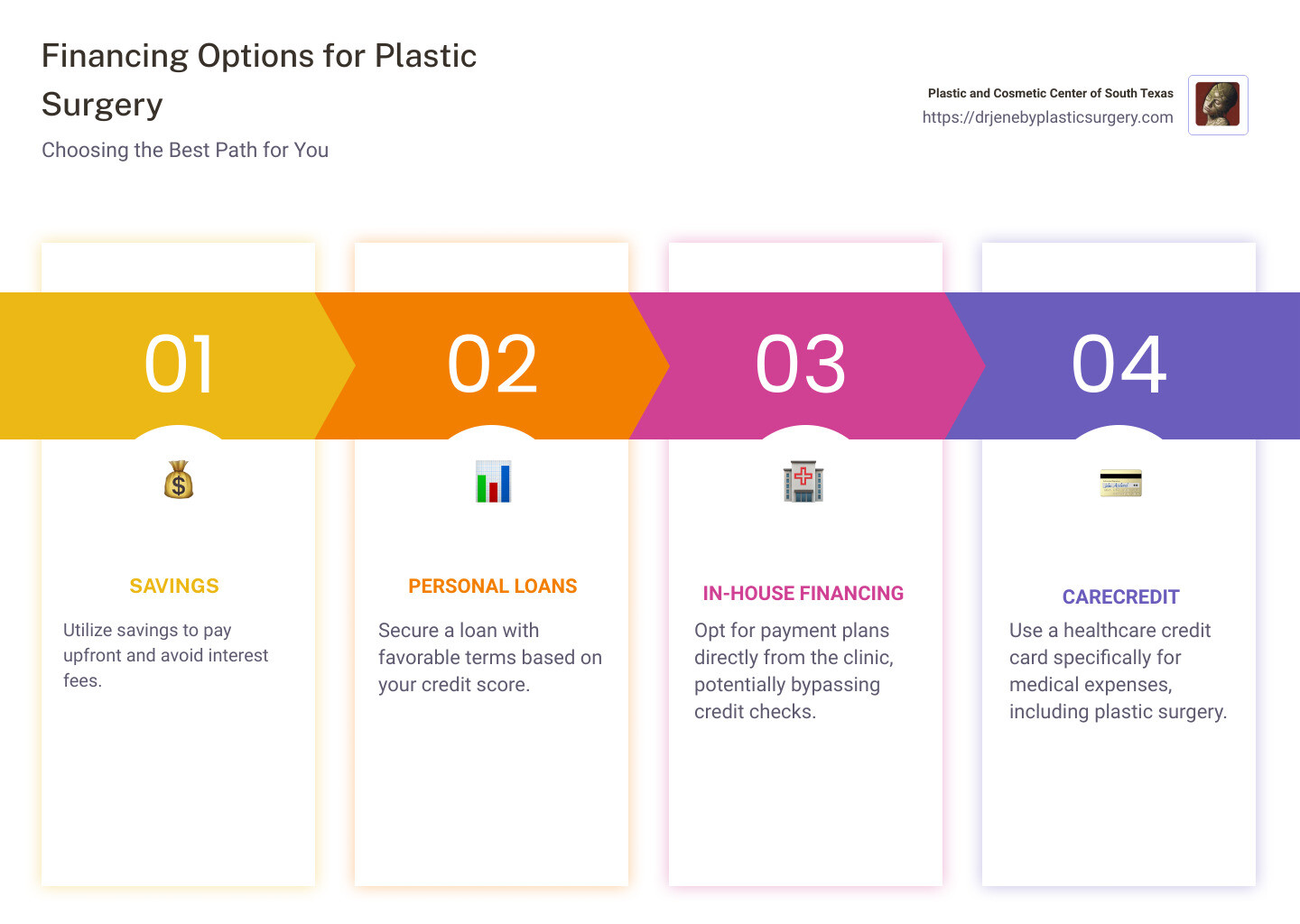
Remember: The best choice depends on your individual financial situation, credit health, and personal priorities. Knowing your options is the first step toward making an informed and empowered decision.

Understanding Plastic Surgery Financing
When you’re looking into how to finance plastic surgery, there are a few key factors you need to consider: credit score, interest rates, loan terms, and the minimum credit score required by lenders. Let’s break these down in simple terms.
Credit Score
Your credit score is like a financial handshake. It tells lenders how reliable you are when it comes to paying back money. A higher score can open the door to better loan terms, such as lower interest rates. If your score is on the lower side, don’t worry. Some options are designed for those with less-than-perfect credit.
Interest Rates
Think of interest rates as the cost of borrowing money. It’s what you pay on top of the loan amount. Rates can vary widely, so it’s smart to shop around. Lower rates mean you pay less over the life of the loan, saving you money. Sometimes, you might find special deals, like zero-interest promotions on credit cards, which can be a huge win if you manage to pay off the loan within the promotional period.
Loan Terms
Loan terms are simply how long you have to pay back the loan. Shorter terms usually mean higher monthly payments, but you’ll spend less on interest overall. Longer terms can lower your monthly payments but increase the total amount of interest you’ll pay. It’s all about finding the right balance for your budget.
Minimum Credit Score
Most lenders have a minimum credit score requirement. This can vary, but knowing where you stand is crucial. Some financing options are more forgiving and cater to a wider range of credit scores. For example, secured loans or specific financing plans might be available even if your credit isn’t top-notch.
Key Takeaways:
- Your credit score is crucial: It affects your eligibility and the terms you’ll get. If it’s low, there are still options, but improving your score can help a lot.
- Interest rates matter: They significantly affect how much you’ll end up paying. Look for the lowest rates you can qualify for.
- Understand loan terms: They impact your monthly payments and the total interest. Choose what fits your budget.
- Know the minimum credit score requirements: This can guide you to the right financing options for your situation.
By understanding these factors, you’re better prepared to navigate plastic surgery financing. It’s all about finding the right fit for your financial situation and ensuring that you can comfortably manage the repayments. Next, we’ll explore the various financing options available for plastic surgery in more detail.
Financing Options for Plastic Surgery
When considering how to finance plastic surgery, you have several options to explore. Each has its benefits and drawbacks, so let’s break them down to help you make an informed decision.
Personal Loans
Personal loans are a popular choice for financing plastic surgery. They are typically unsecured loans, meaning you don’t need to provide collateral. The interest rates can vary widely based on your credit score, but they usually range from 4% to 36%. If you have a strong credit history, you might qualify for the lower end of this range, making it a relatively affordable option.
Credit Cards
Using a credit card can be a good option, especially if you qualify for a card with a 0% introductory APR. This means you can finance your surgery interest-free if you pay off the balance before the promotional period ends. However, be cautious—once the introductory period is over, the interest rate can spike, potentially making this a costly option.
In-House Financing
Some clinics, like the Plastic and Cosmetic Center of South Texas, offer in-house financing plans. These plans can be convenient and sometimes offer competitive interest rates. Plus, the approval process may be more lenient than traditional financing options. However, read the fine print and understand all the terms before committing.
Secured Personal Loans
Secured personal loans are less common for plastic surgery but can be an option if you have collateral, such as a car or home equity, to back the loan. These loans may offer lower interest rates because the lender has less risk. However, you risk losing your collateral if you can’t make the payments.
CareCredit
CareCredit is a medical credit card specifically designed for healthcare expenses, including cosmetic surgery. It offers short-term financing options at no interest if paid in full within the promotional period (usually 6 to 24 months). For longer-term financing, interest rates apply. Approval is based on creditworthiness, and you can apply online to get an instant decision.

Choosing the Right Option for You
Deciding on the best financing option for your plastic surgery requires careful consideration of your financial situation and the cost of the procedure. Here are a few tips to guide you:
- Check your credit score: Knowing your score will help you understand which options you’re likely to qualify for.
- Compare interest rates and terms: Look for the lowest interest rate and terms that fit your budget.
- Consider the total cost: Remember to factor in any fees or charges to understand the total amount you’ll pay over time.
- Read the fine print: Understand all the terms and conditions before you commit to any financing plan.
Financing plastic surgery is a significant decision, but with the right plan in place, you can make your aesthetic goals a reality without breaking the bank. We’ll discuss how to qualify for these financing options and what steps you need to take to secure funding for your procedure.
How to Qualify for Plastic Surgery Financing
Financing plastic surgery might seem daunting, but it’s a straightforward process once you understand the requirements and steps involved. Here’s how you can qualify for plastic surgery financing, focusing on credit score requirements, income verification, and the application processes, including for CareCredit.
Credit Score Requirements
The first step in qualifying for plastic surgery financing is understanding the credit score requirements. Generally, a minimum credit score of 660 is needed for most personal loans. However, some lenders may offer financing to individuals with lower scores, but at potentially higher interest rates. It’s important to check your credit score beforehand to know where you stand.
Income Verification
Lenders want to ensure you have the means to pay back the loan. Therefore, they will require proof of income. The minimum household income to qualify for most plastic surgery loans is around $25,000. You’ll need to provide documents such as pay stubs, tax returns, or bank statements as part of the application process.
Loan Application Process
Applying for a loan involves several steps:
1. Prequalification: Many lenders allow you to prequalify for a loan online by filling out a form with basic information. This step usually doesn’t impact your credit score.
2. Formal Application: After prequalification, you’ll need to complete a formal application. This may involve additional documentation and a hard credit check, which can temporarily affect your credit score.
3. Approval: If you meet the lender’s criteria, you’ll receive a loan offer. This will include the loan amount, interest rate, and repayment terms. Review this carefully before accepting.
CareCredit Application
CareCredit is a popular option for financing plastic surgery. The application process is similar to that of a regular credit card:
1. Check Eligibility: CareCredit requires applicants to have a decent credit score, but they’re known to be more flexible than traditional loan providers.
2. Apply Online or In-Person: You can apply for CareCredit online or through participating healthcare providers. The application will ask for personal and financial information.
3. Instant Decision: In many cases, CareCredit provides an instant decision on your application. If approved, you’ll be informed of your credit limit and can start using it for eligible procedures right away.
Remember, each financing option has its own set of requirements and terms. It’s crucial to read the fine print and understand the costs involved, including any interest and fees.
By keeping these points in mind and preparing accordingly, you increase your chances of qualifying for plastic surgery financing. Whether you choose a personal loan, a medical credit card like CareCredit, or another financing method, make sure it fits your budget and financial plan.
In the next section, we’ll explore the pros and cons of saving versus financing for plastic surgery to help you make an informed decision about the best way to fund your procedure.
Saving vs. Financing for Plastic Surgery
When you’re thinking about how to pay for plastic surgery, you have two main paths: saving up or financing. Let’s break down what each option means for you.
Savings Accounts
Saving up means putting money aside in a savings account until you have enough to cover the cost of your surgery. The big win here is that you pay no interest. Some savings accounts even earn you a bit of money through interest, though it’s usually a small amount.
Here’s the simple truth: if you can wait and save, you’ll spend less overall.
Budgeting for Surgery
Creating a budget for your surgery involves looking at your income and expenses and finding ways to save more. It might mean cutting back on extras or finding ways to increase your income. It’s all about making your surgery a priority in your financial planning.
Cost of Waiting
Waiting has its costs, too. If the surgery will greatly improve your quality of life or self-esteem, delaying it could have emotional or physical costs. This doesn’t show up in dollars, but it’s very real.
Interest Accumulation
Financing your surgery, on the other hand, means you’re borrowing money to pay for it now and paying it back over time. This can be through a personal loan, a credit card, or a medical credit card like CareCredit. The big downside here is interest. Over time, you’ll end up paying more for your surgery than it originally cost.
The longer you take to pay back the loan, the more interest you’ll pay. For example, if you finance $5,000 for surgery at a 10% interest rate over 5 years, you’ll pay over $1,000 extra in interest.
So, how can I finance plastic surgery wisely?
- Compare options: Look at different loans and credit cards to find the lowest interest rate.
- Shorten the loan term: Try to pay the loan off quickly to reduce the amount of interest you’ll pay.
- Consider a medical credit card: Some, like CareCredit, offer periods of 0% interest.
In summary, saving up is the cheapest way to pay for plastic surgery because it avoids interest. But if you need or want the surgery sooner, financing is a viable option—just be smart about it to minimize extra costs.
In our next section, we’ll dive into some common questions about financing plastic surgery to give you even more clarity on your options.
Common Questions on Financing Plastic Surgery
When considering how to finance plastic surgery, many people have questions about the best way to do it, what kind of credit score they need, and specific options like CareCredit. Let’s break these down in simple terms.
How do people finance plastic surgery?
Personal Loan: Many opt for a personal loan because it offers a lump sum of money with a fixed interest rate. The repayment period is set, which means you’ll know exactly when you’ll be done paying it off.
Credit Card: If you have a credit card with a high enough limit, you might consider using it, especially if you qualify for a 0% APR promotion. Just be cautious of high-interest rates after the promotional period ends.
Payment Plan: Some clinics, like the Plastic and Cosmetic Center of South Texas, offer payment plans directly. This can be a convenient option as it’s tailored to the specific services you’re receiving.
What credit score do you need to finance plastic surgery?
The minimum credit score required can vary widely depending on the lender. For most personal loans and credit cards, a score above 600 is a good starting point. However, higher scores generally mean better interest rates and terms. If your score is lower, don’t lose hope. Some lenders are more flexible, especially if you can show a stable income or if you apply with a co-signer.
Other considerations
It’s not just about the credit score. Lenders will also look at your debt-to-income ratio, employment history, and overall financial stability. It’s important to consider whether you can comfortably afford the monthly payments on top of your other expenses.
How hard is it to get CareCredit for plastic surgery?
Applying for CareCredit is straightforward. You can do it online, and it usually involves a quick credit check. Many applicants receive an instant decision, which makes it a popular choice for those looking to finance their plastic surgery quickly. However, approval isn’t guaranteed. Your credit history and score will play significant roles in the decision process.
Remember, while financing can make plastic surgery more accessible, consider all the costs involved, including interest and fees. If possible, compare different financing options to find the one that best suits your financial situation.
In the next section, we’ll wrap things up and provide some final thoughts on financing options at the Plastic and Cosmetic Center of South Texas.
Conclusion
Deciding to embark on the journey of plastic surgery is a significant step towards achieving your aesthetic goals. It’s a decision that involves careful consideration, not just about the procedure itself, but also about how to finance it. At the Plastic and Cosmetic Center of South Texas, we understand that the financial aspect of plastic surgery can often be as daunting as the surgery itself. That’s why we’re committed to making the process as seamless and stress-free as possible.
We’ve explored various financing options, including personal loans, credit cards, and in-house financing. Each of these options has its own set of benefits, and the right choice depends on your individual financial situation and needs. The goal is to find a financing plan that fits comfortably within your budget without compromising your financial stability.
At our center, we believe that financial constraints should not stand in the way of achieving your desired look. That’s why we offer a variety of financing options to ensure that you can access the care you need. Our team is here to guide you through the financing process, helping you understand the terms and conditions, and finding the plan that best suits your budget and lifestyle.
Our experienced surgeons are committed to excellence, combining advanced techniques with compassionate care to achieve outstanding results. They understand the importance of your decision to undergo plastic surgery and are here to support you every step of the way. From the initial consultation to post-surgery care, our surgeons work tirelessly to ensure your safety, comfort, and satisfaction.
Investing in plastic surgery is an investment in yourself. By choosing the right financing option, you can make your cosmetic goals a reality without compromising on quality or experience. If you have any questions or would like to learn more about our services and financing options, please don’t hesitate to contact us. Let us help you take the first step towards the new you.
In conclusion, how you choose to finance your plastic surgery is a personal decision that requires thoughtful consideration. At the Plastic and Cosmetic Center of South Texas, we’re here to provide you with the information and support you need to make the best decision for you. Together, we can achieve the results you desire, making your dream look a reality.


